High-volume kitchens move at a breakneck pace where every second directly impacts service quality. Staff often lose precious time digging through chaotic cold storage during critical dinner rushes. Lost inventory, rampant food waste, and severe thermal loss frequently stem from prolonged searching inside disorganized freezers. When chefs cannot locate ingredients instantly, preparation bottlenecks emerge quickly. The entire kitchen loses its crucial operational rhythm. We wrote this piece to evaluate how visual accessibility solves these specific organizational bottlenecks directly. Structured shelving frameworks prevent lost items and streamline your daily workflow. You will discover practical implementation realities to consider before finalizing any equipment upgrades. We will explore how transparent formats act as robust inventory management tools rather than simple aesthetic upgrades.
Key Takeaways
- Visual Inventory Management: Transparent doors eliminate "blind searching," reducing the time doors remain open and stabilizing internal temperatures.
- Workflow Efficiency: Upright shelving naturally supports strict First-In-First-Out (FIFO) food rotation compared to chest freezers.
- Spatial Economics: Double-door form factors maximize vertical capacity while maintaining distinct categorical zones for food safety.
- Operational Trade-offs: Glass door models require specific anti-fog features and strategic kitchen placement to counter ambient heat and condensation risks.
Why Traditional Freezers Fail at High-Volume Organization
Horizontal storage creates a persistent organizational nightmare for kitchen staff. Kitchens rely heavily on chest freezers for storing bulk goods. This horizontal layout guarantees a dreaded "black hole" effect over time. Cooks stack new deliveries directly over existing older inventory. Older goods sink further toward the bottom shelves daily. Staff inevitably bury critical ingredients deep inside the unit. They cannot reach these items without unloading everything above them first. This cumbersome process leads directly to expired goods and severe frustration. Retrieval times suffer dramatically during any busy shift. A line cook might spend five crucial minutes digging for specific proteins.
Traditional solid door Upright Freezers pose a slightly different operational challenge. Staff must physically open the door to audit current stock levels. They cannot scan shelves visually from the outside area. This constant physical interaction interrupts workflow during peak service hours. Cooks open the door simply to check ingredient availability. Every single door swing allows valuable cold air to escape. The compressor must engage repeatedly to recover the lost thermal energy. These brief but frequent temperature fluctuations degrade food quality over time.
Disorganized freezers carry highly tangible operational costs. Kitchen managers frequently over-order specific items accidentally. They forget about inventory hidden deep inside dark corners. Kitchens throw away freezer-burnt food regularly. Unseen ingredients sit undiscovered for months on end. Increased labor time spent searching translates directly into lost efficiency. Your team wastes expensive labor hours hunting for misplaced proteins. They could spend this valuable time prepping for the dinner rush instead.
The Organizational Mechanics of Visual Accessibility
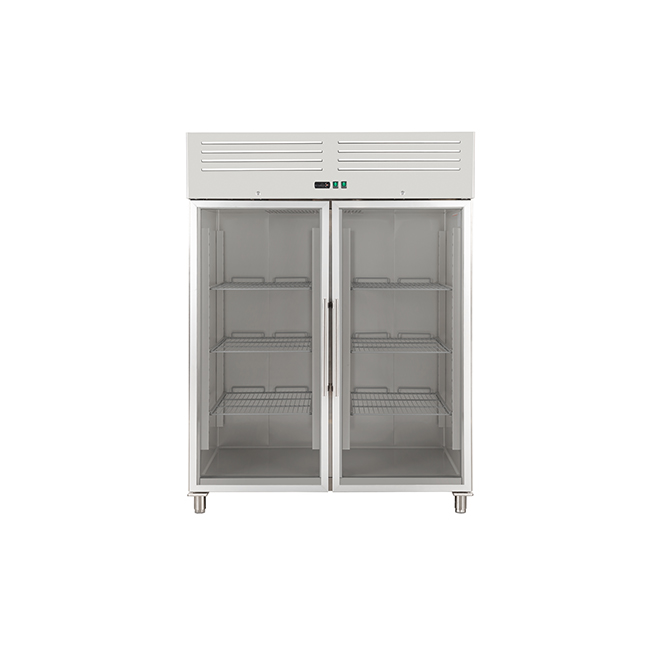
Pre-planning changes how kitchen staff interact fundamentally with cold storage. Double glass doors allow staff to locate items instantly. They establish a clear line of sight seamlessly. Cooks identify the exact ingredient location before touching the handle. Nobody breaks the vital thermal seal until absolutely necessary. This pre-planning reduces open-door duration to mere seconds. Staff grab needed ingredients and close the unit immediately. The internal temperature remains highly stable throughout the entire shift.
Dual compartments enable highly specific micro-zoning strategies. You can achieve both lateral and vertical segmentation easily. Distinct categorical zones keep different ingredient types completely separated.
- Store raw proteins exclusively on the bottom left shelves.
- Place prepared bases and delicate sauces on the top right.
- Keep highly requested garnish items directly at eye level.
- Dedicate lower right sections to heavy bulk vegetables.
This strict separation creates incredibly intuitive storage zones. New hires learn the kitchen layout much faster. They visually memorize where specific categories live.
Transparency offers a remarkably powerful psychological organizational benefit. Visible messes get cleaned up significantly faster. Transparent doors enforce structural discipline among all kitchen staff. Nobody wants to leave a disorganized shelf exposed completely. A messy shelf reflects poorly on the entire prep team. Accountability rises naturally when every item remains clearly on display. The kitchen manager can audit cleanliness from across the room. Staff maintain tidy shelves without requiring constant micromanagement. They recognize the visual standard and uphold it daily.
Implementing FIFO and Food Safety Protocols
Health codes mandate highly specific organizational flows routinely. Proper storage hierarchies prevent disastrous cross-contamination incidents. You must organize shelves based on final cooking temperatures. Implementing a strict top-to-bottom hierarchy is strictly non-negotiable for safety.
- Top Shelves: Ready-to-eat foods and baked goods belong here. These items require zero additional cooking before serving. Placing them high prevents raw juices from dripping downward.
- Middle Shelves: Store prepped ingredients and raw vegetables in this zone. These items undergo some heat treatment. They sit safely below ready-to-eat items but above raw proteins.
- Bottom Shelves: Reserve this entirely for raw meats and poultry. Raw poultry requires the highest internal cooking temperature. Keeping it at the bottom prevents hazardous cross-contamination completely. You eliminate the risk of unsafe juices dripping onto fresh produce.
Structured Upright Freezers naturally support strict food rotation methods. First-In, First-Out (FIFO) execution prevents costly food spoilage. Adjustable wire racks accommodate varying ingredient sizes easily. Staff can execute seamless back-stocking procedures daily. They load fresh deliveries straight from the rear sections. This physical action automatically pushes older inventory forward visually. Cooks pull the oldest items first without thinking twice. Visual accessibility confirms older stock sits at the very front. Managers can verify FIFO compliance through the glass instantly.
Evaluation Framework: Solid vs. Glass Door Upright Freezers
Buyers often express healthy skepticism regarding thermal efficiency. Glass panels inherently provide less baseline insulation than solid metal doors. However, you must view this through a daily operational lens. Visual access drastically reduces total open-door time daily. Cooks never stand in front of open doors scanning shelves. This operational energy savings frequently offsets the lower baseline insulation. We must evaluate where this specific trade-off actually makes sense.
| Feature | Solid Door Models | Double Glass Door Models |
| Thermal Insulation | High baseline insulation. Better for long-term deep storage. | Lower baseline insulation. Offset by shorter open times. |
| Inventory Visibility | Zero visibility. Requires physical door opening to audit. | Full visibility. Allows visual auditing from across the room. |
| Ideal Placement | Remote storage rooms. Static bulk inventory zones. | Active prep areas. High-traffic kitchen stations. |
| Workflow Impact | Slows retrieval. Staff must search blindly inside. | Speeds retrieval. Pre-planning reduces search times. |
Humid kitchen environments pose serious glass fogging risks continually. Buyers must evaluate units featuring specialized anti-condensation technology strictly. Heated glass options prevent moisture buildup effectively. You should also look for double or triple-pane argon-filled glass. The argon gas layer acts as an invisible thermal barrier. It keeps the exterior glass closer to ambient room temperature. This prevents heavy condensation from obscuring your visual inventory.
Aisle space dictates overall kitchen flow and staff safety. Double doors feature a much smaller swing radius. A single large solid door blocks the entire walkway. Two smaller glass doors impact tight kitchens far less. Staff can move past open compartments safely. They do not block colleagues carrying hot pans nearby. You must measure your specific aisle clearance before purchasing.
Implementation Risks and Setup Considerations
Proper placement dictates equipment longevity and daily performance. You must consider ambient temperature realities very carefully. Never place glass door models directly next to heavy heat sources. Ovens, grills, and fryers radiate intense ambient heat continuously. This external heat forces the compressor into overdrive constantly. The unit struggles to maintain safe internal freezing temperatures. High ambient heat also exacerbates exterior glass condensation risks significantly. Strategic kitchen placement ensures the compressor operates within normal limits.
Air circulation requires dedicated physical space inside the cabinet. Staff must leave a crucial two to three inch gap. Keep all inventory away from the back wall completely. Evaporator fans rely on this empty space to distribute cold air. Overpacking shelves directly blocks these essential airflow channels. Restricted airflow causes highly uneven freezing patterns inside. Some items might thaw while others suffer severe freezer burn. You must observe stated load-bearing limits strictly. Commercial shelves typically hold fifty to ninety pounds comfortably. Overloading causes wire racks to bow and eventually collapse entirely.
Smart accessory integration maximizes available shelf space efficiently. We highly recommend utilizing clear slotted polycarbonate bins. They group small or loose items together neatly. Bagged items often slide around on bare wire racks. Bins contain these awkward items perfectly. The slotted design ensures cold air continues circulating freely. Solid bins trap warmer air and slow down the freezing process. Staff can slide these slotted bins out like standard drawers. They can access items nestled in the deep back easily.
Conclusion
Double glass door upright freezers represent serious operational investments. They drastically improve daily inventory accuracy. These models function best inside active prep areas. They do not belong in remote static storage rooms. Transparent equipment transforms chaotic kitchens into highly streamlined environments. Staff find ingredients faster and reduce overall food waste.
Assess your current kitchen footprint and aisle clearance carefully. Track your daily door-opening frequency accurately. This helps gauge potential energy savings for your specific workflow. Calculate your monthly inventory loss rates to justify the equipment upgrade. Review manufacturer spec sheets thoroughly before making decisions.
Confirm the presence of argon-filled anti-fog glass technology. Evaluate heating elements designed to stop exterior condensation. Compare compressor warranties before shortlisting specific unit capacities. Take accurate measurements of your prep line today. Your team deserves reliable equipment built for fast-paced culinary environments.
FAQ
Q: Do glass door upright freezers consume more electricity than solid doors?
A: Yes, they often consume slightly more baseline electricity. Glass panels offer lower insulation values than solid foam-filled doors. However, operational energy loss decreases significantly. Cooks locate items visually before opening the handle. This dramatically shortens open-door durations. The compressor runs less frequently to recover lost cold air.
Q: How do you organize deep shelves without losing items in the back?
A: We recommend using modular bin systems. Slotted polycarbonate bins act like slide-out drawers. They prevent loose items from vanishing into dark corners. You must also implement strict back-to-front loading protocols. Load fresh deliveries directly behind older stock to ensure proper rotation.
Q: Can a commercial double glass door freezer be used in a residential garage?
A: You should exercise extreme caution here. Unconditioned residential garages experience wild ambient temperature swings. High summer heat severely overworks commercial compressors. Extreme cold winter temperatures confuse the thermostat sensors. Furthermore, commercial units generate significant noise. They lack proper acoustic insulation for quiet residential spaces.
Q: What is the standard weight capacity for commercial upright freezer shelves?
A: Standard commercial shelves typically hold fifty to ninety pounds comfortably. Heavy-duty models might support slightly more weight. You must verify exact benchmarks based on your specific inventory density. Overloading shelves restricts vital airflow and causes wire racks to bow dangerously.


