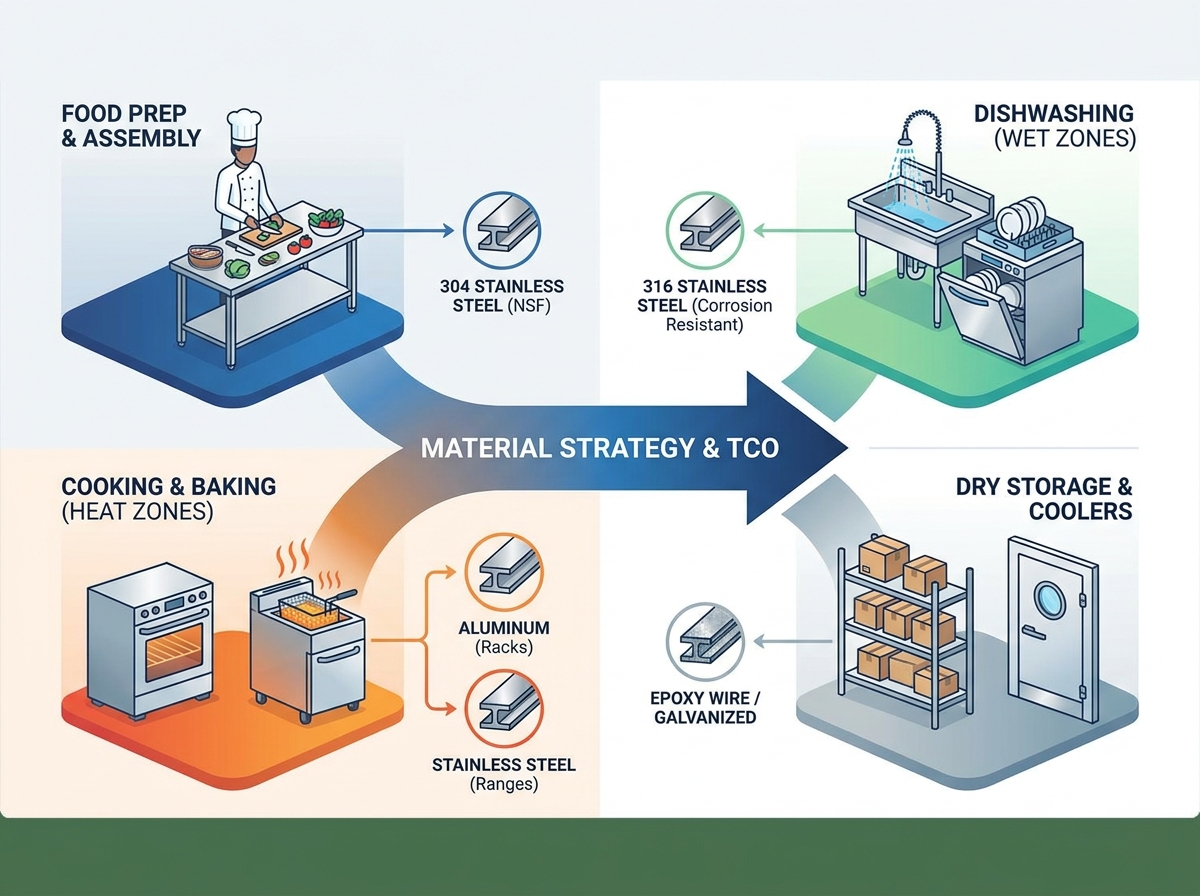
Selecting the right materials for a professional kitchen goes far beyond basic design preferences. It represents a critical operational expenditure and a foundational compliance decision. High-volume kitchens expose surfaces to a harsh daily reality. Constant moisture, extreme heat, highly acidic ingredients, and harsh chemical cleaners constantly attack these work areas. If you choose weak materials, they will degrade rapidly under these stressful conditions.
This article evaluates stainless steel against aluminum, galvanized steel, and commercial composites. We aim to help buyers specify the exact materials needed for their Commercial Kitchen Equipment. You will learn to navigate health compliance, evaluate structural durability, and maximize your equipment's lifecycle value. Understanding these material differences protects your investment and ensures uninterrupted daily service.
Key Takeaways
Grade Matters: Not all stainless steel is equal; selecting between 300-series (304/316) and 400-series (430) determines corrosion resistance and magnetic properties.
Strategic Allocation: Cost-efficiency is achieved by matching material types to specific kitchen zones (e.g., aluminum for heat transfer in baking, 316 stainless for high-salinity wash areas).
Compliance Baseline: Ensure all food-contact equipment meets NSF/ANSI standards regardless of the base material to avoid regulatory penalties.
The Business Impact of Material Selection in Commercial Kitchen Equipment
Degraded equipment disrupts your daily workflows significantly. When surfaces pit or rust, staff must spend more time scrubbing them. This increases your daily labor costs and slows down critical food prep. Kitchen managers often underestimate the hidden labor expenses tied to poorly specified materials. Durable surfaces clean quickly, keeping your staff focused on cooking rather than maintenance.
Porous or degrading materials easily harbor dangerous pathogens. Health inspectors look very closely at surface integrity during routine visits. Failed health inspections damage your brand reputation severely. Fines and forced closures cost far more than purchasing premium materials initially. Upgrading your Commercial Kitchen Equipment ensures continuous regulatory compliance.
Baseline materials usually last around three to five years before failing. High-grade alternatives easily survive 10 to 20 years in active kitchens. Evaluating capital expenditure requires looking past the initial sticker shock. Investing heavily upfront in premium metals reduces disruptive replacement cycles. You avoid the hidden costs of dismantling and reinstalling heavy fixtures every few years.
Stainless Steel Grades and Specifications: A Buyer's Evaluation
Buyers must understand metal grading to make informed purchasing decisions. The industry categorizes stainless steel by its chemical composition.
The 300 Series (304 & 316)
Type 304 serves as the undisputed industry standard. It contains high amounts of nickel and chromium. This specific blend provides excellent rust resistance. We highly recommend it for general prep tables and standard sinks. It forms a passive layer blocking oxidation.
Type 316 represents the premium tier of kitchen metals. Manufacturers add molybdenum to this alloy mixture. This addition makes the steel strictly necessary for high-chloride environments. You must use it for seafood prep stations and intense dishwashing zones. Regular 304 steel will eventually pit when exposed to heavy salts.
The 400 Series (430)
This series features a noticeably lower nickel content. It serves as a budget-friendly option for cost-conscious operators. You should use it for dry environments and equipment housing. It fits perfectly for side panels and enclosed cabinet bases. However, it remains highly vulnerable to pitting in wet zones. Never use 430 steel for your main washing sinks.
18-Gauge: Light duty and economy use. Best for sandwich shops or low-volume cafes.
16-Gauge: Standard commercial applications. Ideal for busy restaurants needing reliable daily performance.
14-Gauge: Heavy duty and high-impact zones. Perfect for butchers and heavy pounding stations.
Aluminum vs. Stainless Steel: Balancing Cost and Performance
Aluminum boasts superior thermal conductivity compared to steel alloys. It transfers heat quickly and evenly across its surface. It is also significantly lighter, making mobility much easier. Aluminum dominates the market for baking sheets and speed racks. Professional bakers rely heavily on its rapid cooling properties.
However, bare aluminum has severe structural and chemical limitations. It dents very easily under heavy commercial use. Sheet pans often warp under extreme thermal stress. Furthermore, aluminum reacts aggressively to highly acidic or alkaline foods. Ingredients like tomatoes, vinegar, or citrus can alter food taste. These reactions also discolor the bare metal permanently.
Aluminum offers a highly cost-effective solution for specific tasks. It works best for non-structural applications. You must keep bare aluminum away from direct wet prep zones. Use it strategically to save money without compromising sanitation. Consider anodized aluminum if you need chemical resistance on a budget.
Galvanized Steel and Composites as Alternative Options
Manufacturers create galvanized steel by coating standard steel in zinc. This zinc layer acts as a sacrificial barrier against rust.
The implementation risk for galvanized steel remains extremely high. The zinc coating inevitably scratches during busy service hours. Once scratched, the underlying raw steel rusts rapidly. Humid kitchen environments accelerate this corrosion exponentially. We recommend galvanized steel only for dry storage shelving. You can also safely use it for hidden structural framing.
Commercial-grade plastics and polymers offer excellent modern alternatives. High-density polyethylene (HDPE) works perfectly for color-coded cutting boards. Epoxy-coated wire suits cold storage and walk-in cooler shelving beautifully. These materials offer vital antimicrobial properties. You can also replace them easily and cheaply when they finally wear out.
Decision Framework: Choosing the Right Commercial Kitchen Equipment by Zone
Smart buyers allocate their budget based on specific kitchen zones. Below is the Kitchen Zone Material Matrix to guide your procurement strategy.
Kitchen Zone
Recommended Material
Primary Justification
Food Prep and Assembly
16-Gauge, Type 304 Stainless Steel
Ensures strict NSF compliance and prevents bacterial growth.
Combats constant exposure to water, steam, and abrasive chemicals.
Dry Storage / Coolers
Epoxy-Coated Wire / Galvanized Steel
Provides a cost-saving alternative for non-wet, non-prep areas.
For food prep and assembly, you must prioritize direct food contact safety. We recommend 16-gauge, Type 304 stainless steel. Direct food contact requires absolute sanitation. This ensures full NSF compliance and protects public health.
In cooking and baking zones, divide your materials by function. We recommend aluminum for mobile racks and specific baking pans. Use heavy stainless steel for ranges, deep fryers, and exhaust hoods. They provide maximum heat and grease resilience.
Dishwashing and janitorial spaces require maximum corrosion resistance. Strictly use Type 304 or 316 stainless steel here. These areas face constant exposure to standing water. Industrial steam and abrasive chemical cleaners will destroy lesser materials quickly.
Dry storage and walk-in coolers allow for budget flexibility. You can safely use epoxy-coated wire or heavy-duty polymers. Galvanized steel also works well if kept perfectly dry. These provide substantial cost-saving alternatives to pure stainless steel shelving.
Shortlisting Vendors and Implementation Risks
Some equipment vendors mask 430-grade stainless as "premium commercial steel." They might also obscure the actual metal gauge in their marketing. Always demand detailed material specification sheets before buying. You must verify the exact chemical grade and thickness. Trustworthy dealers provide this documentation without hesitation.
Look very closely at the fabrication and welding details. Demand Tungsten Inert Gas (TIG) welding for all joints. This method creates a seamless, sanitary finish. Fully hemmed edges eliminate dangerous sharp corners. Unhemmed edges create severe safety hazards for your kitchen staff. Poor welding also leaves microscopic crevices where dangerous bacteria thrive.
Never finalize a procurement order based purely on visual appearance. Always require concrete proof of NSF/ANSI certification. These independent certifications prove the equipment meets strict public health standards. Installing uncertified fixtures often leads to immediate health code violations. Upgrading your Commercial Kitchen Equipment safely demands rigorous vendor vetting.
Conclusion
Purchasing commercial kitchen fixtures is an exercise in serious risk mitigation.
Aluminum and galvanized materials serve very specific, limited niche roles.
Type 304-grade stainless steel remains the undisputed baseline for long-term compliance.
Audit your current kitchen blueprints to identify specific environmental zone risks.
Request exact material specification sheets from your dealers for your next procurement phase.
FAQ
Q: Does stainless steel equipment ever rust?
A: Yes. It is "stain-less," not stain-proof. The metal relies on a microscopic passive chromium layer to resist oxidation. Abrasive scrubbing pads, bleach, or harsh chlorine cleaners can easily destroy this protective layer. Once compromised, the underlying steel will develop surface rust rapidly. Proper cleaning requires non-abrasive tools and suitable stainless steel polishes.
Q: Is it safe to use aluminum equipment for food prep?
A: It remains safe for many general uses, especially baking. However, highly acidic foods like tomatoes, vinegar, or citrus react aggressively with bare aluminum. This reaction leaches a metallic taste into the food. It also pits and discolors the equipment. You must use anodized aluminum or stainless steel for acidic food preparation.
Q: What is the difference between 18-gauge and 16-gauge stainless steel tables?
A: The gauge number dictates metal thickness. A lower number means thicker steel. A 16-gauge table is significantly thicker than an 18-gauge table. It offers superior dent resistance for heavy commercial chopping and meat pounding. This added structural integrity easily justifies the initial price upgrade for high-volume restaurants.
Q: Can I use magnetic hooks on stainless steel kitchen equipment?
A: It depends entirely on the metal grade. The budget-friendly 400-series contains less nickel and is highly magnetic. Premium 300-series steel generally contains high nickel and is non-magnetic. Using a basic magnet provides operators a fast, practical test to identify their equipment's underlying grade and overall corrosion resistance.